

 Asian Tech Stocks Lead Regional Markets Lower
Asian tech stocks declined sharply on Thursday as investors reassessed elevated artificial-intelligence expectations following a weaker technology session on Wall Street.
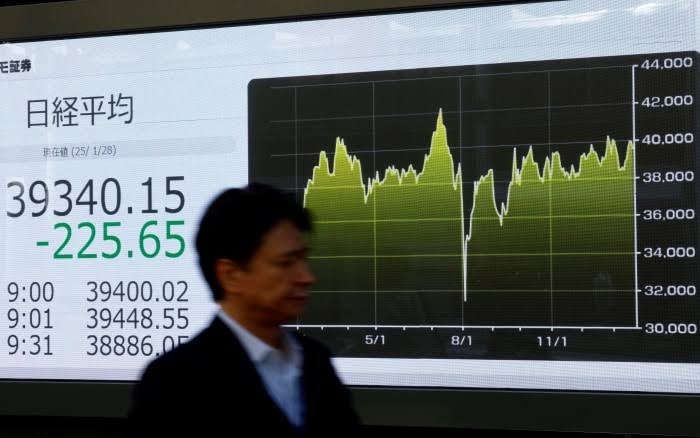
The MSCI Asia-Pacific index excluding Japan fell approximately 0.69%. South Korea’s KOSPI dropped around 3.64%, while Japan’s Nikkei 225 declined approximately 1.57%.
Samsung Electronics lost approximately 2.44%, SK Hynix fell around 6.95%, Kioxia dropped approximately 9.61%, and Tokyo Electron declined about 4.61%.
The pullback suggests investors are becoming more selective after substantial gains and increasingly demanding evidence that high spending on AI infrastructure will generate sustainable earnings.
The decline in Asian tech stocks reflects a reassessment of expectations rather than a broad rejection of the long-term AI investment theme.
Wall Street Weakness Spreads to Asia
The regional decline followed a weaker session for US technology shares, during which the Nasdaq ended a multi-day winning streak.
SpaceX and Advanced Micro Devices came under pressure after their quarterly results. Although AMD exceeded analysts’ estimates, its performance did not satisfy the market’s elevated expectations.
A company can exceed formal forecasts and still experience a falling share price if investors have already priced in a substantially stronger outcome.
- Strong AI demand raises share prices.
- Higher prices increase valuation multiples.
- Investors expect accelerating earnings.
- Companies report results above formal forecasts.
- The results fail to exceed broader market expectations.
- Profit-taking spreads across related technology shares.
Semiconductor Shares Face Higher Expectations
Semiconductor companies have become central to the global AI investment cycle because data centres require advanced processors, memory chips, networking equipment and manufacturing tools.
Samsung Electronics and SK Hynix are major participants in the memory market. Kioxia is exposed to flash-memory demand, while Tokyo Electron supplies semiconductor-manufacturing equipment.
Investors are evaluating whether data-centre investment can continue growing, whether chip supply will eventually exceed demand and whether hyperscalers are generating sufficient returns from AI services.
A temporary decline does not necessarily mean AI demand is weakening. However, it shows that Asian tech stocks may require stronger earnings visibility to justify further valuation expansion.
AI Spending Remains a Powerful Driver
Capital expenditure by Alphabet, Microsoft, Amazon, Meta Platforms and Oracle is expected to approach $800 billion in 2026, according to Goldman Sachs strategists cited by Reuters.
More than 75% of S&P 500 companies had reported second-quarter results by Wednesday. Adjusted earnings were on track to increase approximately 31.1% from the previous year, according to LSEG IBES data.
Technology-sector earnings were projected to rise around 72%, indicating that the AI investment cycle is producing measurable corporate earnings.
Nevertheless, suppliers may remain vulnerable if major technology companies signal slower spending, longer investment-payback periods or higher operating costs.
Valuations Have Moderated
The S&P 500’s forward price-to-earnings ratio stood near 20.4, compared with approximately 22.2 at the end of 2025. The technology sector’s multiple declined from around 26.5 to 22.1.
The Philadelphia Semiconductor Index remained approximately 17% below its late-June peak, despite gaining more than 70% during 2026.
Lower valuations can create a healthier foundation if profit forecasts remain intact. However, Asian tech stocks may remain volatile because the sector is exposed to concentrated positioning and rapidly shifting sentiment.
US Payroll Data Becomes the Next Test
ADP data showed that US private employers added approximately 44,000 jobs in July, slowing from 95,000 in June and falling around 25,000 below expectations.
Economists surveyed by Reuters expect official nonfarm payrolls to show an increase of approximately 80,000 jobs in July, following a gain of 57,000 in June. The unemployment rate is forecast to remain at 4.2%.
A weaker report could reduce Federal Reserve tightening expectations and support technology valuations through lower yields. However, a significantly weak result could increase concern about economic growth and corporate demand.
Treasury Yields Remain a Valuation Risk
The US 10-year Treasury yield declined to approximately 4.607% during Asian trading.
Futures markets assigned approximately a 54% probability to a Federal Reserve rate increase in September, down from around 58% one day earlier.
If yields fall because inflation is easing while growth remains stable, Asian tech stocks may benefit. If yields decline because investors expect a severe slowdown, weaker earnings expectations could offset that advantage.
Oil Developments Affect Risk Sentiment
Brent crude traded around $79.31, while WTI was near $74.96 as markets assessed the possibility of an agreement involving Iran, Oman and the United States.
Prospects for reopening the Strait of Hormuz have reduced some inflation concerns, contributing to lower Treasury yields.
Renewed conflict or another surge in oil prices could raise inflation expectations, push yields higher and create additional pressure on growth-oriented equities.
Implications for Major Instruments
The KOSPI remains highly sensitive to semiconductor movements because Samsung Electronics and SK Hynix carry substantial index weightings.
The Nikkei 225 may respond to global technology shares and USDJPY. A stronger yen can reduce the translated value of overseas earnings for Japanese exporters.
The Nasdaq 100 will provide an important signal for Asian tech stocks. Stabilisation in US semiconductor shares could support a regional recovery, while further selling may extend the correction.
USDJPY traded near 157.66 following the historic joint currency intervention by Japan and the United States.
What Traders Should Monitor Next
- US nonfarm payrolls and wage growth.
- The US unemployment rate.
- The US 10-year Treasury yield.
- Federal Reserve rate expectations.
- Nasdaq and semiconductor-index performance.
- Hyperscaler capital-expenditure plans.
- Memory-chip prices and order demand.
- Samsung Electronics and SK Hynix price action.
- KOSPI and Nikkei 225 movements.
- USDJPY following joint intervention.
- Brent crude’s position around $80.
Market Outlook
Asian tech stocks are experiencing a significant test after an AI-driven rally raised earnings and valuation expectations.
The fundamental background remains constructive. Hyperscaler investment continues to support semiconductor demand, while US corporate and technology-sector earnings are growing strongly.
However, strong results may no longer be sufficient. Companies must demonstrate that AI investment can generate durable returns while maintaining capital expenditure and profit margins.
A moderate slowdown in employment accompanied by lower yields could support a recovery. Strong labour data may revive rate concerns, while a substantially weaker report could increase fears about economic demand.
Until earnings guidance and economic data provide greater clarity, Asian tech stocks may remain volatile and particularly sensitive to AI spending, interest rates and global risk sentiment.
DISCLAIMER: Derivative products carry high risk and may result in the loss of your entire invested capital. Before trading, ensure you fully understand the legal framework, product characteristics and your broker’s trading rules. Always trade responsibly and with caution.
RISK WARNING: Margin trading with leverage is not suitable for all investors due to its high risk. THERE ARE NO GUARANTEED RETURNS in trading. Beware of claims promising assured profits. Only use capital you can afford to lose. Before entering any transaction, ensure you understand the risks and assess your experience and risk tolerance.
