

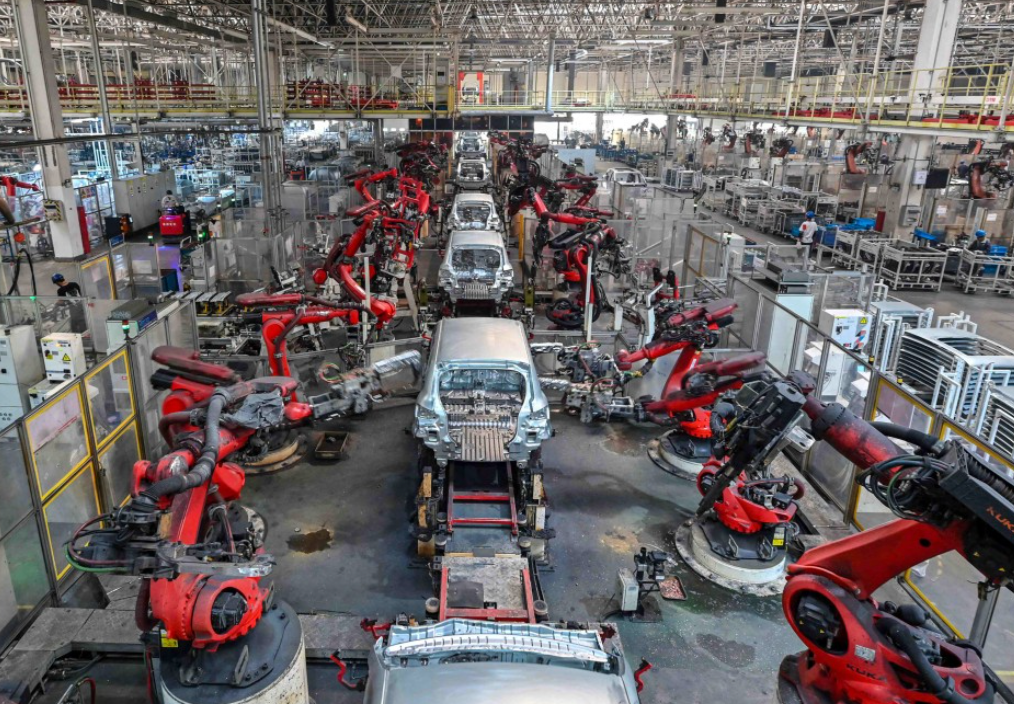
 China High-Tech Manufacturing Powers Growth
China high-tech manufacturing is emerging as one of the country's strongest economic engines, even as broader growth remains uneven across regions and industries. New data highlights how advanced manufacturing hubs are expanding at a faster pace than many traditional industrial centres, reinforcing Beijing's long-term strategy of moving the economy toward higher-value production.
While parts of China's economy continue to face challenges from a weak property market and cautious consumer spending, China high-tech manufacturing has maintained solid momentum. Industries such as electric vehicles, batteries, semiconductors, and advanced machinery are attracting investment, creating jobs, and supporting industrial output.
According to Reuters, the contrast between regions has become increasingly noticeable. Some provinces are benefiting from rapid technological development, while others that rely more heavily on traditional manufacturing or real estate continue to experience slower economic growth.
Why High-Tech Manufacturing Is Leading China's Growth
The rise of China high-tech manufacturing reflects years of strategic investment by the Chinese government.
Beijing has prioritised advanced industries through supportive industrial policies, research funding, and incentives aimed at strengthening domestic innovation. The objective is to reduce dependence on foreign technology while building globally competitive manufacturing capabilities.
These efforts are beginning to produce measurable results. Production of electric vehicles, renewable energy equipment, industrial robots, and semiconductor-related products has expanded significantly over recent years. Many of China's fastest-growing industrial cities are now closely linked to these advanced manufacturing sectors.
Interestingly, this shift represents more than a temporary economic trend. It reflects a structural transformation that could reshape the landscape of China high-tech manufacturing for many years to come.
Regional Growth Is Becoming More Uneven
Despite the success of China high-tech manufacturing, the country's overall economic performance is becoming increasingly uneven.
Provinces with strong technology ecosystems and advanced manufacturing clusters are recording healthier growth than regions still dependent on construction, heavy industry, or property development.
Cities that have successfully attracted technology investment are seeing stronger industrial production, rising exports, and greater private sector activity. Meanwhile, areas with less exposure to high-value manufacturing continue to face slower economic expansion.
Let that sink in: two provinces operating under the same national economic policies can experience very different growth trajectories depending on the industries that dominate their local economies.
That divergence has become one of the defining features of China's current economic recovery, according to Bloomberg.
Electric Vehicles and Semiconductors Continue to Expand
Several industries are driving the success of China high-tech manufacturing, including:
- Electric vehicles and battery production
- Charging infrastructure and related supply chains
- Semiconductor manufacturing equipment
- Industrial robotics and automation
China remains one of the world's largest producers of electric vehicles, with domestic manufacturers continuing to expand both production and exports. Demand for batteries, charging infrastructure, and related supply chains has supported investment across multiple provinces.
The semiconductor sector also remains a major focus. Although geopolitical tensions and export restrictions continue to create challenges, China has accelerated efforts to strengthen domestic chip production. Significant capital has been directed toward semiconductor manufacturing equipment, research facilities, and advanced production capacity.
These industries have become central pillars of China high-tech manufacturing, helping offset weakness in sectors that previously contributed more heavily to overall economic growth.
Government Policy Continues to Shape Investment
Government support remains an important factor behind the expansion of China high-tech manufacturing.
Chinese policymakers have consistently emphasised innovation, advanced production, and technological self-sufficiency as key national priorities. Financial incentives, tax benefits, and industrial development programmes have encouraged companies to invest in higher-value manufacturing.
This policy direction has also influenced private investment decisions. Businesses increasingly recognise that sectors aligned with government priorities may enjoy stronger long-term support, encouraging additional spending on research, production facilities, and technological development.
While global demand conditions remain important, domestic policy continues to provide a relatively stable foundation for investment in China high-tech manufacturing, according to the Financial Times.
Challenges Still Remain
The strength of China high-tech manufacturing does not eliminate the broader challenges facing the country's economy.
The property sector continues to weigh on household confidence, while domestic consumption has recovered more slowly than many economists anticipated. External demand also remains subject to changing global economic conditions and trade policies.
In addition, rising competition within several technology industries could place pressure on profit margins over time.
What Investors Are Watching
Market participants will continue monitoring whether China high-tech manufacturing can sustain its current momentum over the coming quarters.
Future economic data will provide additional insight into industrial production, export performance, and private investment. Investors will also assess whether stronger manufacturing activity eventually spreads into other parts of the economy, supporting broader domestic growth.
Meanwhile, developments in global trade, technology regulations, and geopolitical relations could influence the outlook for China high-tech manufacturing, particularly for industries closely connected to international supply chains.
- Industrial production data in coming quarters
- Export performance of advanced manufacturing goods
- Private sector investment trends
- Global trade and technology policy shifts
The coming months may therefore offer a clearer picture of how durable this transformation will be, according to Reuters.
Conclusion
For now, China high-tech manufacturing stands out as one of the country's strongest economic performers. While the broader recovery remains uneven, advanced industries are helping reshape the economy, strengthen industrial competitiveness, and reinforce China's position as a global manufacturing leader.
